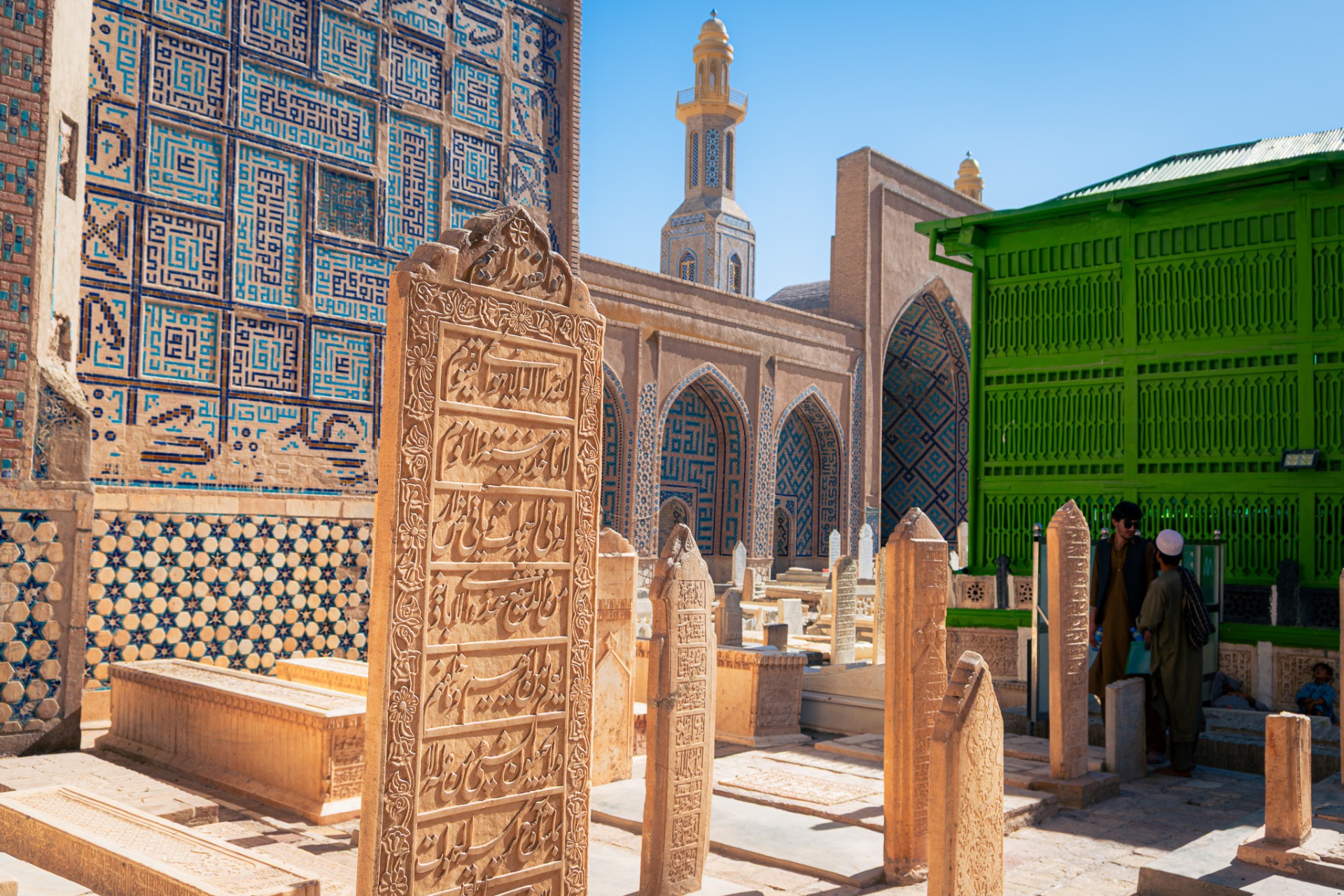
In the village of Gazurgah, just beyond the city of Herat, lies one of western Afghanistan’s most important spiritual places. At its heart is the grave of Khwaja Abdullah Ansari, the eleventh-century mystic, scholar and poet remembered simply as Pir-e Herat — the Saint of Herat. For almost a thousand years, people have come here to pray, reflect and pay their respects. What began with the simple grave of a revered teacher gradually became a magnificent complex of courtyards, gardens, graves and richly decorated architecture. Yet Gazurgah has never become merely a monument to the past. It remains a place of pilgrimage and contemplation — somewhere history is still part of everyday life.
History & Details
Khwaja Abdullah Ansari was born in Herat in 1006 and spent much of his life studying, teaching and writing. Known for his religious scholarship and deeply spiritual writings, he became one of the most celebrated mystic voices associated with medieval Herat. After his death in 1089, he was buried at Gazurgah, and his grave gradually developed into an important place of pilgrimage. More than three centuries later, during Herat’s extraordinary flowering under the Timurids, Shah Rukh, son of Timur, transformed the site. In 1425, he commissioned the great funerary enclosure that still defines Gazurgah today. The work is associated with the renowned architect Qavam al-Din Shirazi. A monumental iwan rises above Ansari’s grave, while the courtyard is surrounded by arches, chambers and historic tombs. Traces of turquoise tilework, geometric decoration and elegant calligraphy reveal the refinement of Timurid Herat. The complex continued to grow under later Timurid patrons. Princes, poets, scholars, officials and Sufi figures were buried around Ansari, gradually turning Gazurgah into a remarkable landscape of memory. Nearby gardens and buildings such as the Zarnigar Khana and Namakdan Pavilion became part of the wider ensemble. Through all these changes, Ansari’s grave remained its spiritual centre.
Gallery
Visitor Experience
“Gazurgah feels different from Herat’s grand mosques, citadel and busy bazaars. Entering the complex, you step into a quieter world of old trees, weathered gravestones, blue tilework and people who still come here for reasons that have little to do with tourism. The architecture invites you to slow down. Look closely and fragments of Timurid decoration appear above the arches. Walk through the courtyard and centuries of Herat’s history lie almost side by side in the graves surrounding Ansari. But the most memorable part of Gazurgah is its atmosphere. This is not a historic site that has lost its original meaning. People still visit the grave, sit beneath the trees, pray and spend time in contemplation, continuing a tradition that began centuries ago. For travellers, that creates a rare connection between past and present. At Gazurgah, you do not simply visit the resting place of a man who lived almost a thousand years ago — you experience how his words, memory and spiritual legacy remain part of Herat today.”
Trips That Visit Khwaja Abdullah Ansari Shrine
Don't see a trip that fits? We can build one entirely around the places you want to see.
Plan a Custom Visit