13 Days
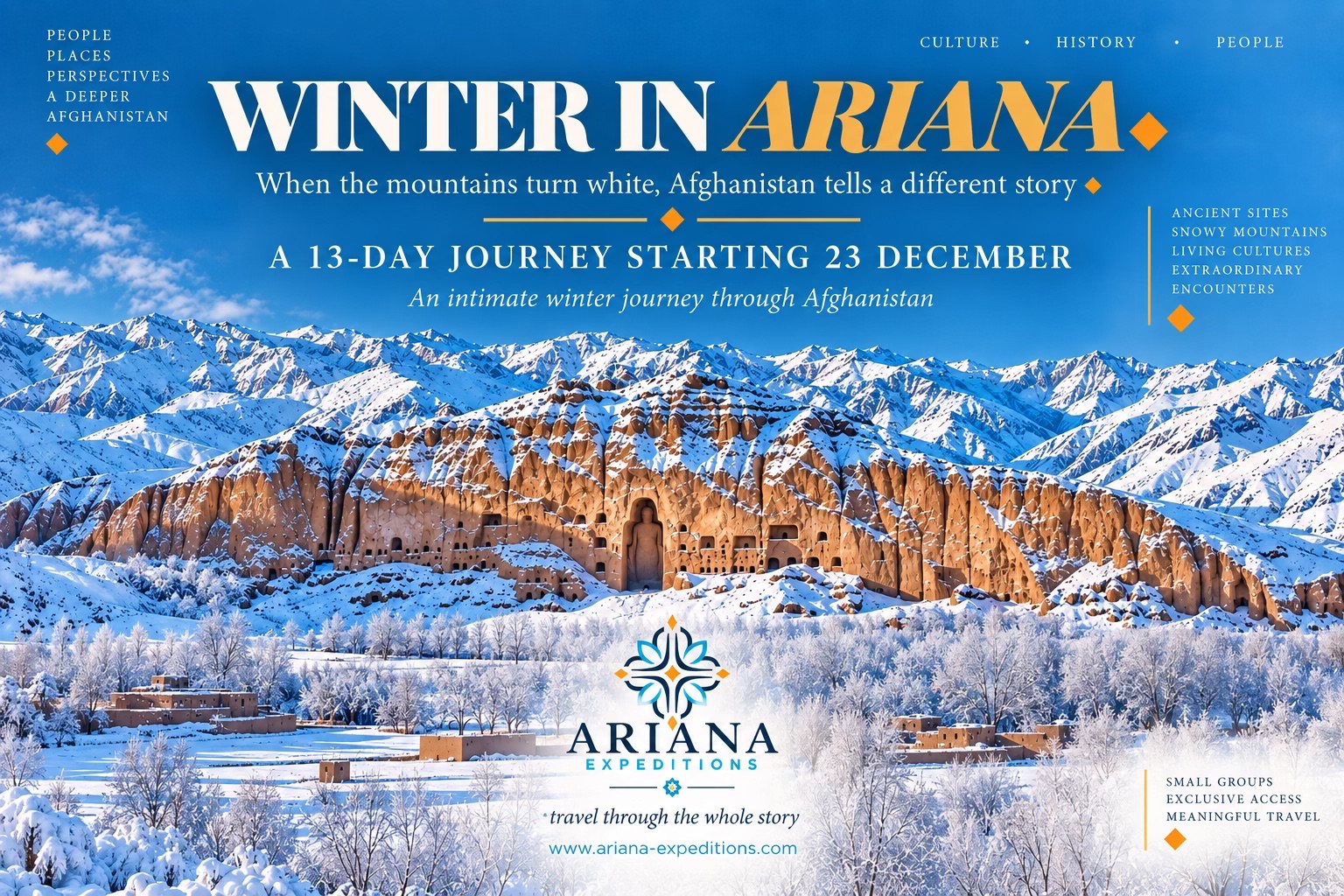
There is an Afghanistan that only winter reveals Snow settles over the mountains. Ancient cities grow quieter. Behind heavy doors, there is warmth, conversation and always another glass of tea. Outside, the landscapes of Afghanistan become something entirely different This December, Winter in Ariana invites you into that world For 13 days, we travel through Kabul, Ghazni, Kandahar, Herat, Bamyan, Samangan and Mazar-e-Sharif — discovering ancient cities, Buddhist heritage, magnificent mosques, snow-covered valleys and the warmth of Afghan hospitality along the way But perhaps the moments you remember most will be the simplest ones: warming your hands around a glass of tea, sharing a meal after a winter journey, or waking to mountains covered in fresh snow 13 days · starting 23 December Small group · fully organised · limited places
Your journey begins in Kabul, a city of lively bazaars, historic neighbourhoods and unexpected moments. We will meet you at the airport and take you to your hotel. Depending on your arrival time, we can begin exploring the city with a walk through Mandawi Bazaar and Kabul’s atmospheric Old Bird Market. If you would like to wear traditional Afghan clothing during the journey, we can also visit a local tailor. We visit the distinctive Shah-Do Shamshira Mosque beside the Kabul River and experience the rhythm of the old city: shopkeepers opening their doors, tea being poured and people moving through streets shaped by generations of history. There is no need to rush. Your first day is about arriving, looking around and allowing Kabul to reveal itself.
Today we fly north to Mazar-e Sharif. At the heart of the city stands the magnificent Blue Mosque. Its turquoise tiles, elegant courtyards and white doves make it one of Afghanistan’s most memorable places. We take time to explore both the shrine and the city around it. Mazar is colourful, welcoming and full of everyday life, offering a gentle introduction to northern Afghanistan. The timing of the domestic flight determines the exact programme. If circumstances allow, we may visit Babur’s Garden in Kabul before departure.
A short journey brings us to ancient Balkh, one of the legendary cities of the Silk Road. For centuries, travellers, merchants, poets and pilgrims passed through this region. Different religions and cultures all left their traces here, creating a place with an extraordinary depth of history. We walk among the remains of the old city and visit Haji Piyada, Afghanistan’s oldest known mosque and a remarkable example of early Islamic architecture. We also explore sites connected with Rumi, the celebrated Persian poet and mystic who was born in this region. If a local buzkashi match is taking place, we will try to attend. This spectacular horseback sport cannot be scheduled in advance, which makes witnessing it even more special.
We travel south through the beautiful Tashqurghan Valley towards Samangan and Pul-e Khomri. Along the way, we visit the Jahan Numa Palace and Garden before continuing to Takht-e Rostam, one of Afghanistan’s most surprising archaeological sites. This ancient Buddhist stupa and monastery were carved directly into the rock. Unlike a traditional stupa built above ground, Takht-e Rostam was created by cutting down into the hillside, making it unlike almost anything found elsewhere in the region. Surrounded by open landscapes and far from the busiest routes, it is a quiet and atmospheric place to explore. We spend the night in Pul-e Khomri.
Today the road itself becomes part of the journey. We travel into the mountains of central Afghanistan, following remote roads through the Hindu Kush towards Bamyan. The landscape changes gradually as wide plains give way to mountain valleys, small villages and dramatic passes. We take our time, stopping for photographs, tea and lunch along the way. These unplanned pauses often become some of the most memorable moments of the journey. By evening, we arrive in Bamyan and settle into a traditional local guesthouse surrounded by the mountains.
Bamyan is one of Afghanistan’s most beautiful and culturally significant regions. We visit the great Buddha niches carved into the cliffs above the valley and explore the surrounding caves and archaeological landscape. Although the statues themselves are gone, their scale and setting still offer a powerful impression of the Buddhist civilisation that once flourished here. We then continue to Band-e Amir, a spectacular chain of intensely blue mountain lakes surrounded by pale cliffs and open highland landscapes. Back in Bamyan, there is time to explore the bazaar, meet local people or simply pause for tea and take in the peaceful atmosphere of the valley.
We begin the day in Kakrak Valley, a quiet and rarely visited part of the wider Bamyan cultural landscape. Ancient Buddhist caves are scattered through the cliffs, including the niche that once held the Standing Buddha of Kakrak. With few other visitors and mountains in every direction, the valley offers an intimate encounter with Afghanistan’s distant past. We continue to Shahr-e Zuhak, the dramatic Red City that once guarded the eastern approach to Bamyan. Its ruined walls rise above the meeting of the rivers, with far-reaching views across the surrounding valleys. From Zuhak, we begin our journey towards Ghazni.
Ghazni was once the capital of a powerful empire and an important centre of art, learning and architecture. We explore the historic city, including the famous Minarets of Ghazni and the remains of its citadel. If access is possible, we will also visit the Ghazni Museum. Afterwards, we continue south towards Kandahar. As the landscape changes, we pass through towns and settlements rarely seen by international visitors. The journey offers a sense of Afghanistan’s immense scale and the remarkable variety found between its different regions.
Kandahar has played a central role in Afghanistan’s story and remains one of the country’s most distinctive cities. We visit Chil Zena, the Forty Steps carved into the mountainside above Kandahar, and the tomb of Mirwais Khan Hotak. We also explore places connected with Ahmad Shah Durrani, founder of the Durrani Empire and a key figure in the creation of modern Afghanistan. Other visits include the Red Mosque, the city’s bustling bazaars and, when access is possible, the revered Shrine of the Cloak. We will also try to visit Ahmad Shah Durrani’s former residence if circumstances allow. In Kandahar, history is not separated from daily life. It remains visible in the city’s traditions, architecture and identity.
Today we cross western Afghanistan on the long road to Herat. The landscapes gradually open and change as we travel west. There will be opportunities to stop for photographs, drink tea, enjoy local food and experience the small encounters that make travelling overland so rewarding. This is more than a transfer between two cities. It is a chance to experience the distances, landscapes and diversity that shape Afghanistan. By evening, we arrive in Herat and check into our hotel.
Herat is one of the great cultural cities of the region and a beautiful final chapter of our journey across Afghanistan. We visit the magnificent Friday Mosque, celebrated for its brilliant blue tilework and peaceful courtyards, before exploring the ancient Citadel of Herat. At the Musalla Complex, the remaining minarets recall the period when Herat was a flourishing centre of poetry, art, architecture and learning. We also visit a traditional tile workshop to see how the city’s famous blue and turquoise decorations are still produced by hand. Additional visits include Herat’s historic synagogue and the Jihad Museum, each revealing a different part of the city’s long and layered story. Herat is a place where history remains alive—in its workshops, monuments, gardens and streets.
We fly back to Kabul for the final day of the journey. Depending on the flight schedule, we can visit the National Museum of Afghanistan and discover objects representing thousands of years of cultural exchange. We continue to Maranjan Hill, where local people come to drink tea, play cricket, fly kites and look out across the capital. It offers a final view of Kabul shaped not by monuments, but by the people simply enjoying their city. There will also be time for some final shopping, perhaps on Chicken Street, and for one last Afghan meal together.
After breakfast, we will take you to Kabul International Airport for your flight home. Over thirteen days, you will have crossed Afghanistan from north to west, travelled through the Hindu Kush and visited cities that once stood at the heart of great civilisations. You will have encountered Buddhist heritage, Silk Road history, Islamic architecture, spectacular mountain landscapes and the artistic traditions of Herat. But the journey is also shaped by smaller moments: a shared cup of tea, a conversation beside the road, an unexpected invitation or a view that makes you ask the driver to stop. You leave with more than photographs. You leave having travelled through the whole story.