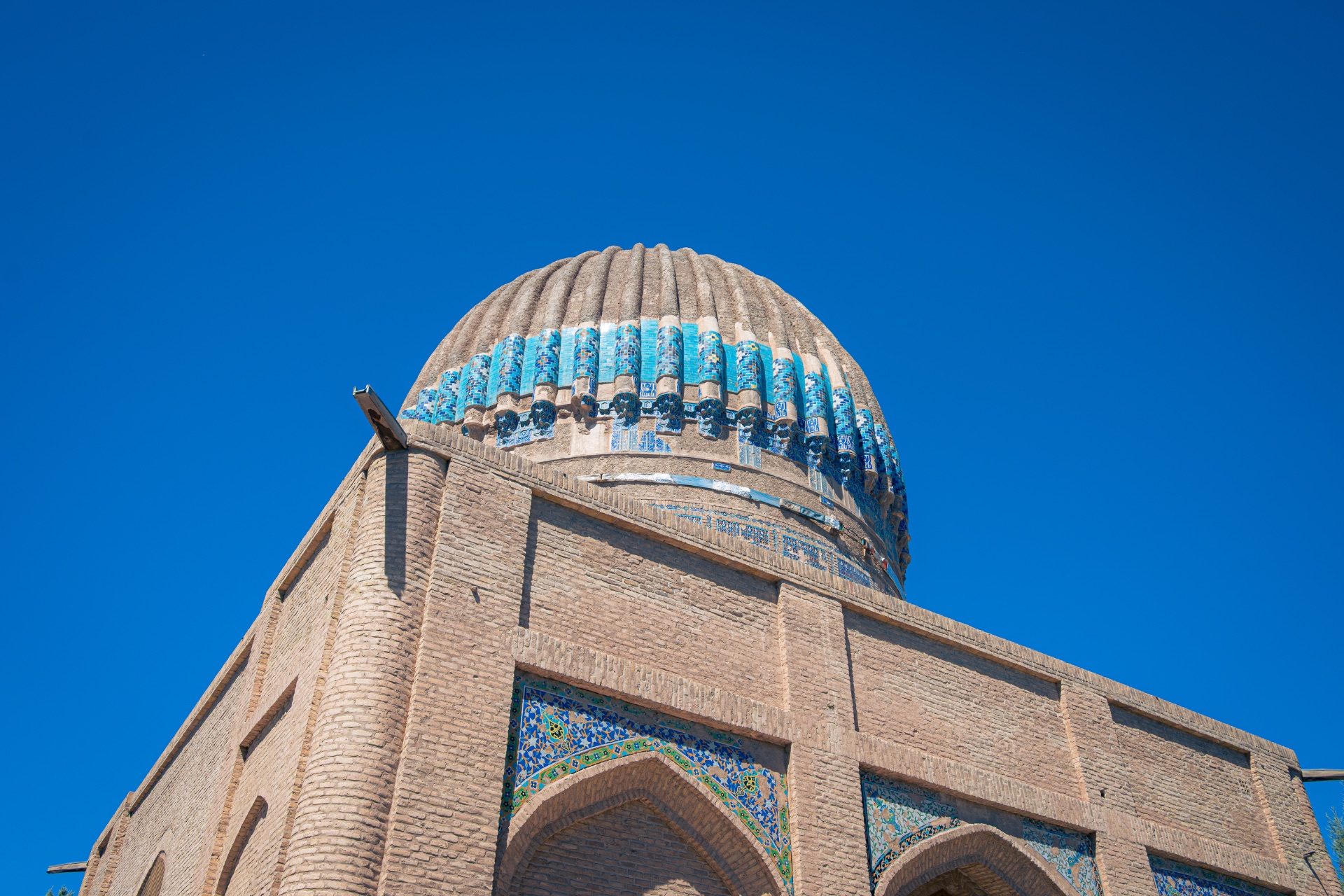
Some rulers leave their names in chronicles. Gowhar Shad left hers in cities. In fifteenth-century Herat, at the height of the Timurid age, she stood close to the centre of one of the most powerful courts of her time. Yet her legacy was not built through politics alone. Gowhar Shad understood that power could also be expressed through architecture, learning, poetry and beauty. Under her patronage, architects, craftsmen and scholars helped transform Herat into one of the great cultural centres of the Islamic world. Today, much of the monumental world she created has disappeared. But beneath the turquoise dome of her mausoleum, something of it remains: the story of a woman who helped shape not only a dynasty, but an age.
History & Details
Gowhar Shad was the wife of Shah Rukh, son of Timur, but describing her only through her marriage understates her position. Historical accounts record her influence in dynastic and administrative affairs, particularly in the politics surrounding her sons and grandsons. Even after Shah Rukh's death in 1447, she remained deeply involved in the struggle over Timurid succession until her death in 1457. Her most enduring exercise of power, however, may have been cultural. Together with Shah Rukh and members of their family, Gowhar Shad belonged to a generation of patrons under whom Herat became a remarkable centre of architecture, scholarship and the arts. She commissioned major religious and educational buildings and employed Qavam al-Din Shirazi, one of the foremost architects of the Timurid world. Her patronage extended far beyond Herat: the magnificent mosque bearing her name beside the shrine of Imam Reza in Mashhad was completed in 1418. In Herat, her ambitions were even greater. Beginning in 1417, she commissioned a vast mosque and madrasa complex as part of what became the Musalla ensemble. Its architecture was covered in polychrome glazed tiles, calligraphy and elaborate ornament; interiors incorporated muqarnas, geometric decoration and pigments including gold and lapis lazuli. The complex was not simply monumental architecture. Religious learning, scholarship, craftsmanship and artistic production were woven into the cultural world surrounding the Timurid court. The mausoleum formed part of this ensemble. Beneath its distinctive ribbed dome were buried members of the Timurid royal family, including Gowhar Shad herself and her son Baysunghur. The surviving interior retains painted and stucco decoration, while the exterior preserves traces of the intricate tilework for which Timurid Herat became celebrated. What survives today is only a fragment of the original vision. Much of the Musalla was destroyed or damaged over succeeding centuries; particularly devastating was the demolition of parts of the complex in 1885, when British forces cleared the area in anticipation of a Russian attack on Herat that never came. Earthquakes and later conflicts caused further losses. Yet the surviving dome, mausoleum and minarets still reveal the extraordinary scale of Gowhar Shad's ambition. Her monument was not simply a tomb constructed for eternity. It belonged to an entire intellectual and artistic landscape she helped create.
Gallery
Visitor Experience
“Approaching the mausoleum today means encountering that history through what remains. The great complex that once surrounded it has largely vanished, leaving the turquoise dome and surviving minarets standing almost improbably against the open sky of Herat. From a distance they appear delicate. Up close, fragments of tile, calligraphy and decoration reveal just how sophisticated this architecture once was. Inside, the experience becomes quieter. The scale contracts from empire to individual: beneath the dome lie Gowhar Shad and members of the dynasty whose court helped make Herat one of the cultural capitals of its age. The woman responsible for monumental mosques, madrasas and generations of artistic patronage rests within one of the buildings she herself commissioned. That contrast is what makes the place so compelling. Her empire fragmented. Much of her architectural world was destroyed. The artists and scholars of Timurid Herat disappeared centuries ago. But look upward at the painted interior of the dome, or at the surviving turquoise against the Afghan sky, and her idea of power remains surprisingly legible. For Gowhar Shad, beauty was not separate from power. It was one of the ways power could leave something behind.”


Don't see a trip that fits? We can build one entirely around the places you want to see.
Plan a Custom Visit