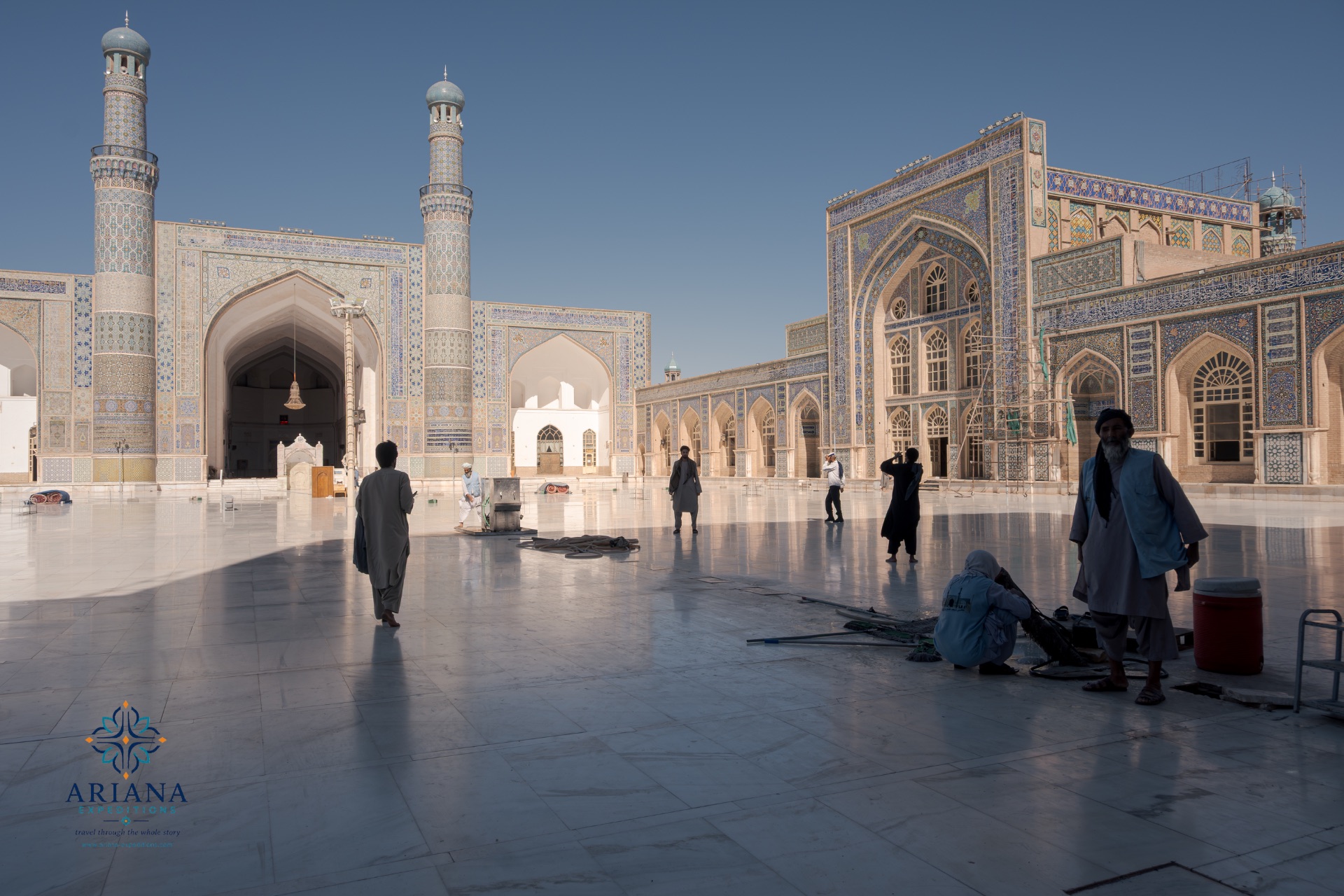
A Courtyard of Colour Behind the busy streets of Herat lies a sudden world of colour. Passing through the gates of the Masjid-e Jami of Herat, the city seems to fall away and an immense courtyard opens before you, surrounded by soaring façades covered in turquoise, blue and white. Known in English as the Friday Mosque or Great Mosque of Herat, the Masjid-e Jami is one of Afghanistan’s great architectural landmarks. Yet its beauty is not the creation of a single moment. For more than eight centuries, successive rulers, architects and craftsmen have rebuilt, expanded and decorated the mosque. The result is a monument that does not simply belong to Herat’s history. It continues to be part of the living city around it.
History & Details
The story of the present mosque begins with the Ghurid ruler Ghiyath al-Din Muhammad, who commissioned a great mosque here around 1200. Parts of that early Ghurid building survive, including a remarkable portal decorated with calligraphy and geometric ornamentation. Over the centuries, the mosque changed with Herat itself. Different dynasties repaired and expanded the complex, but the Timurid period brought another extraordinary chapter. When Herat flourished as one of the great artistic and intellectual centres of the Persianate world, its architects and craftsmen further enriched the mosque. Its design follows the classical four-iwan plan: a vast rectangular courtyard surrounded by arcades, with monumental vaulted iwans opening from its four sides. Across the façades, geometric patterns, floral motifs and calligraphy dissolve into an intricate surface of glazed tile. Much of the decoration visible now also tells a more recent story of conservation and craftsmanship. Generations of Herati artisans have worked to preserve and restore the mosque, continuing techniques associated with the city's architectural tradition. Nearby, the mosque's tile workshop reveals how this heritage survives: clay is shaped, painted, glazed, fired and cut by hand before individual pieces become part of the enormous patterns covering the building.
Gallery
Visitor Experience
“Few photographs prepare you for the moment you enter the courtyard. Suddenly there is space, symmetry and colour. Minarets rise above walls covered in thousands of pieces of tile, while shades of turquoise and deep blue change constantly beneath the Afghan sun. From across the courtyard, the decoration seems almost like a single painted surface. Walk closer and that illusion disappears. Vast patterns break apart into countless individual fragments — flowers, stars, lines of calligraphy and tiny pieces of coloured ceramic, each placed by hand. That is what makes a visit to the nearby tile workshop such a meaningful addition. After watching a craftsman shape a single piece of tile with a hammer, you return to the courtyard understanding the building differently. What first appeared monumental suddenly becomes deeply human. The Masjid-e Jami is not only one of Herat’s great monuments. It is centuries of art, faith and craftsmanship, assembled piece by piece — and a tradition that is still being passed from one pair of hands to the next.”
Trips That Visit Masjid-e Jami of Herat
Don't see a trip that fits? We can build one entirely around the places you want to see.
Plan a Custom Visit