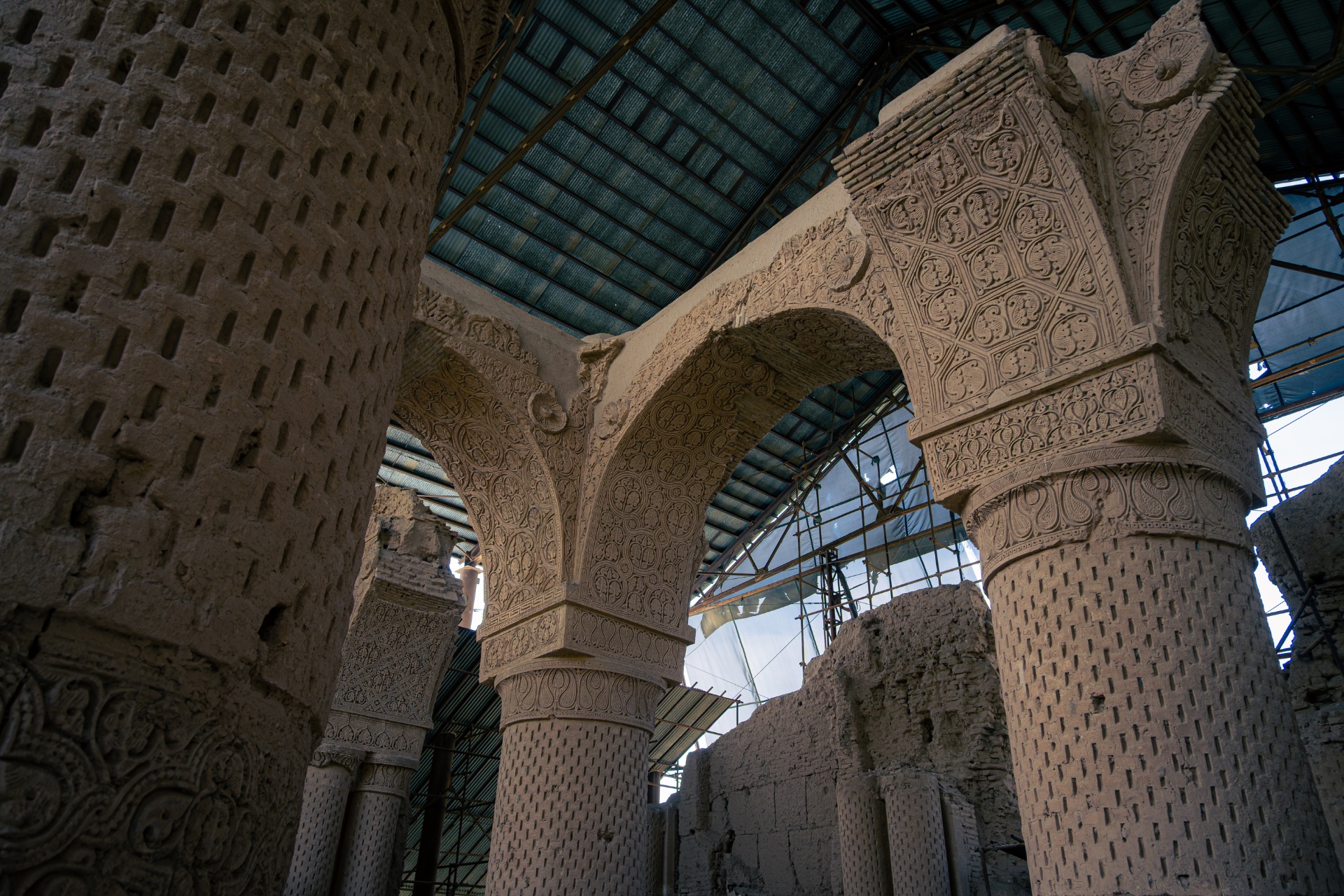
The Nine Domes of Balkh A few kilometres beyond the ancient walls of Balkh stands a modest monument with an extraordinary place in Afghanistan’s history. Haji Piyada Mosque, also known as Noh Gonbad — the Nine Domes —, is considered one of the earliest surviving Islamic monuments in the country. At first sight, little remains of its former grandeur. Its domes have disappeared and centuries have reduced much of the building to fragments of walls, arches and columns. Yet beneath its protective roof survives something remarkable: delicate carved decoration from the earliest centuries of Islam in this part of the world. In a region shaped by Zoroastrianism, Buddhism and later Islam, Haji Piyada captures one of those moments when Afghanistan’s story was beginning to change.
History & Details
Haji Piyada was built during the early Islamic period, probably in the late eighth or ninth century. Its original design was beautifully simple: a square building divided into nine equal sections, each covered by its own dome, giving the mosque its name, Noh Gonbad. None of the nine domes survives, but the arches and columns beneath them preserve the mosque’s greatest treasure. Their surfaces are covered with exceptionally intricate carved stucco — swirling vines, leaves, geometric forms and abstract patterns shaped into the plaster with astonishing precision. The decoration places Balkh within a much wider artistic world. Similar ideas appeared across the early Islamic lands, while elements of older Central Asian and Persian artistic traditions continued to influence the craftsmen working here. Haji Piyada therefore belongs not only to the history of Islamic architecture, but to the long story of cultural exchange that has always defined Balkh. Recent archaeological research has even suggested that the mosque may have been constructed within the wider area once associated with Nava Vihara, the celebrated Buddhist complex of ancient Balkh. If so, its location adds another remarkable layer to the site: new traditions emerging within a landscape that had already been sacred for centuries.
Gallery
Visitor Experience
“Haji Piyada does not impress through size. Its power lies in intimacy. Walking beneath the protective structure, you come remarkably close to the surviving columns and arches. From a distance they appear weathered and fragile; closer inspection reveals an extraordinary world of decoration. Patterns emerge from the ancient plaster, their shadows changing as you move around them. Knowing that nine domes once rose above these columns requires imagination. But that is also part of the experience. What survives is enough to reveal the skill of its builders, while what has disappeared leaves space to picture the mosque as it might have stood more than twelve centuries ago. And perhaps nowhere is the layered history of Balkh more tangible. Not far away lie the remains of its Buddhist past, while here stands one of Afghanistan’s earliest Islamic monuments. At Haji Piyada, different chapters of Afghanistan’s history do not simply follow one another — they seem to meet in the same landscape.”
Trips That Visit Haji Piyada Mosque
Don't see a trip that fits? We can build one entirely around the places you want to see.
Plan a Custom Visit