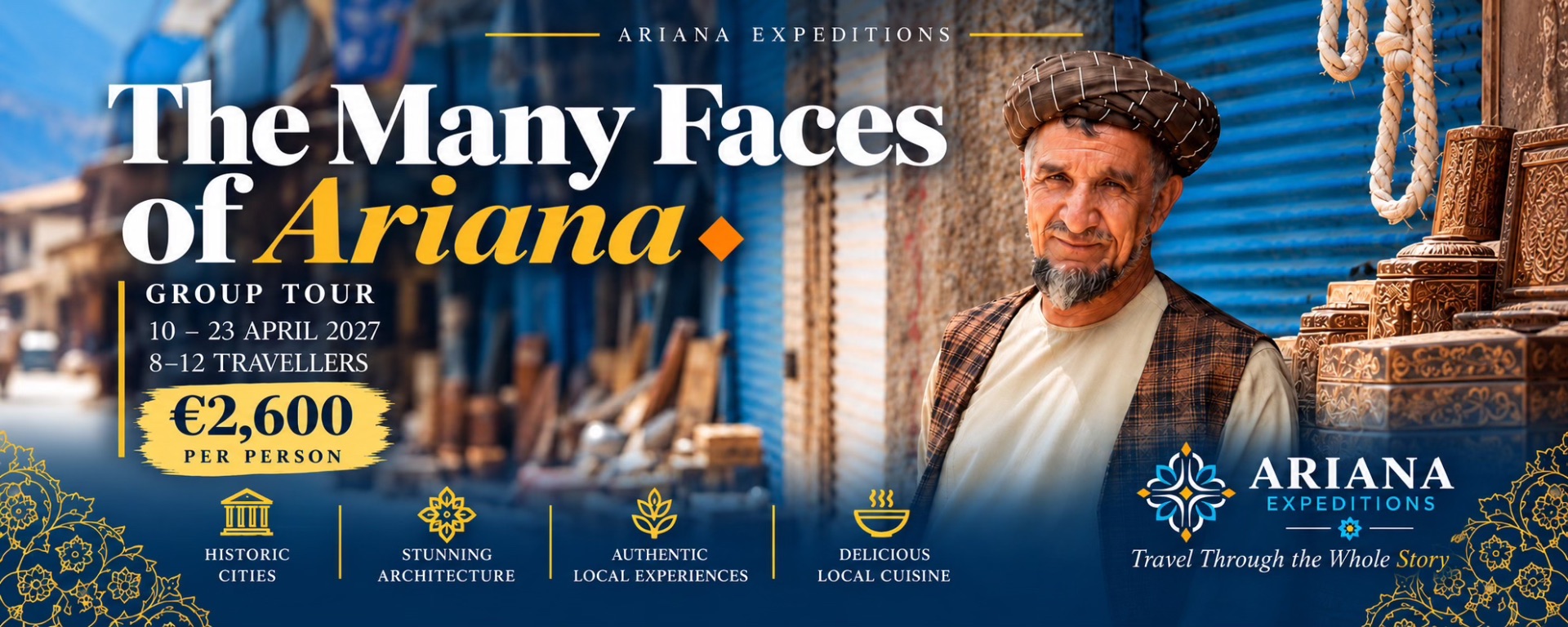
14 Days
Afghanistan is not a country that can be understood through headlines, nor through a collection of monuments. Its story lives in the people who call it home: in the hands of craftsmen, the conversations of merchants, the hospitality of families and the traditions passed from one generation to the next. The Many Faces of Ariana is a journey across Afghanistan's extraordinary cultural landscape. From the elegant tilework of Herat to the lively bazaars of Kandahar, from the ancient Buddhist valleys of Bamyan to the historic crossroads of Balkh, we travel through a country shaped by countless civilisations, languages and traditions. But the true heart of this journey lies beyond its celebrated landmarks. We take time to meet the people behind the places. To listen to their stories, discover their crafts, share conversations over tea and experience the rhythms of everyday life. A workshop becomes an opportunity to understand a family tradition. A bazaar reveals more than trade. A simple invitation to sit down can become one of the most memorable moments of the journey. Travelling overland through much of Afghanistan is an essential part of the experience. The landscapes change, the architecture takes on different forms, and each region introduces us to new customs, perspectives and ways of life. With local knowledge, genuine curiosity and an openness to the unexpected, we discover an Afghanistan that is both remarkably diverse and deeply connected. Fourteen days. Many faces. One extraordinary story.
Your journey begins in Kabul, a city where centuries of history meet the energy of contemporary Afghanistan. Upon arrival, you will be welcomed by your local Ariana guide and transferred to your accommodation. This first day is about settling in, getting acquainted and beginning to discover the country through the eyes of someone who calls it home. Over tea, we introduce the journey ahead: the regions we will cross, the cultures we will encounter and the many stories waiting to be discovered. Overnight: Kabul
A domestic flight takes us west to Herat, one of the great cultural centres of the Persian-speaking world. Herat has long been a meeting place of poets, scholars, merchants and artists. Its architectural heritage reflects a remarkable history of creativity and cultural exchange. As we begin exploring the city, we discover that its artistic traditions are not confined to the past. The colours, patterns and craftsmanship that made Herat famous continue to inspire the people who live and work here today. Overnight: Herat
Today we discover Herat beyond its celebrated monuments. The magnificent Friday Mosque introduces us to centuries of artistic achievement, its intricate tilework revealing the extraordinary skill of generations of craftsmen. We explore the historic bazaars, where merchants continue traditions of trade that have connected Herat with the wider region for centuries. Where possible, we visit local workshops and meet artisans who keep traditional skills alive. Herat is a city best experienced through its details: the sound of work in a small workshop, the patterns of handmade tiles, the conversations of shopkeepers and the generosity of people who invite us to share a moment of their day. Overnight: Herat
Leaving Herat, we travel overland towards Kandahar, crossing the changing landscapes of western and southern Afghanistan. This is more than a transfer between two cities. Travelling by road allows us to observe the rhythms of life beyond the major urban centres: roadside tea houses, agricultural communities, small settlements and the everyday movement of people across the country. Along the way, we gain a deeper understanding of Afghanistan's geographical and cultural diversity. Our destination is Kandahar, a city with a distinct identity and a central place in Afghan history. Overnight: Kandahar
Kandahar offers a different perspective on Afghanistan. We explore its historic neighbourhoods, traditional bazaars and important cultural landmarks, including the Shrine of the Cloak, an important place in the city's religious heritage. Yet our greatest interest lies in the life unfolding around these places. Through encounters with local merchants, craftspeople and residents, we discover the traditions, hospitality and everyday customs of southern Afghanistan. Rather than rushing from one landmark to another, we allow time for conversations and unexpected encounters, discovering a city through the people who know it best. Overnight: Kandahar
We travel north through Zabul province towards Ghazni, once the capital of a powerful empire whose influence extended far beyond the borders of present-day Afghanistan. Ghazni's historic minarets and monuments recall an era when the city was an important centre of scholarship, literature and architecture. As we explore, we look beyond the grandeur of its past to discover the contemporary city: its streets, bazaars and the people whose everyday lives continue among these remarkable reminders of history. Here, as throughout our journey, the past and present are inseparable. Overnight: Ghazni
Our journey continues into the central highlands, where Afghanistan's landscapes change dramatically. We arrive in Bamyan, a region known for its remarkable natural beauty, rich cultural heritage and the traditions of its Hazara communities. The monumental Buddha niches tell the story of a time when Bamyan was an important centre of Buddhist culture and a crossroads of the ancient Silk Roads. We also explore Shahr-e Gholghola, the City of Screams, overlooking the valley. Beyond these historic sites, we discover the character of Bamyan itself: its villages, agricultural landscapes and the warmth of local encounters. Overnight: Bamyan
Today we explore two very different expressions of Bamyan's heritage. At Band-e Amir, a series of extraordinary blue lakes lies among the rugged mountains of the central highlands. The landscape offers a striking contrast to the historic cities visited earlier in our journey. We also visit Kakrak Valley, where the remains of ancient Buddhist sites reveal another chapter in the region's cultural history. Along the way, we encounter rural life in the highlands, where farming, family traditions and a close relationship with the landscape continue to shape daily existence. This is a day to appreciate not only Bamyan's celebrated scenery but also the people and communities who give the region its character. Overnight: Bamyan
Leaving Bamyan, we journey towards northern Afghanistan. The road takes us through changing mountain scenery, valleys and settlements, offering a fascinating glimpse into the diversity of the country's landscapes and communities. We make stops along the way when circumstances allow, experiencing the small details of life on the road: a roadside market, a conversation over tea or a moment of hospitality. Our destination is Pol-e Khomri, an important crossroads connecting central and northern Afghanistan. Overnight: Pol-e Khomri
Takht-e Rustam and Jahan Numa Palace We continue into Samangan, a region whose history stretches back to the ancient civilisations of Central Asia. At Takht-e Rustam, we discover an extraordinary Buddhist stupa carved directly into the rock, a remarkable reminder of Afghanistan's diverse religious and cultural past. We also visit Jahan Numa Palace, whose architecture reflects another chapter in the region's history. Between these sites, we discover the local landscape, settlements and everyday life of Samangan. The region reminds us that Afghanistan's cultural identity has never been shaped by a single civilisation, but by centuries of encounters, exchanges and influences. Overnight: Mazar-e Sharif
Today we explore Balkh, one of the oldest and most historically significant cities in the region. For centuries, Balkh was a meeting place of merchants, scholars, poets and travellers. Buddhist, Zoroastrian and Islamic traditions have all contributed to its extraordinary cultural legacy. We visit the beautiful Shrine of Khwaja Abu Nasr Parsa and explore the historic surroundings of the ancient city. But Balkh is more than its remarkable past. In its streets and bazaars, we discover the lives of the people who continue to shape its identity. Conversations with local residents reveal how history, faith, family and everyday traditions remain closely connected. Overnight: Mazar-e Sharif
A domestic flight takes us from Mazar-e Sharif back to Kabul. Having travelled through western, southern, central and northern Afghanistan, we return to the capital with a broader understanding of the country's remarkable diversity. The remainder of the day offers an opportunity to rest, reflect on the journey and enjoy the atmosphere of Kabul. Overnight: Kabul
Our final full day is dedicated to Kabul, a city shaped by centuries of cultural exchange and the lives of people from across Afghanistan. We explore historic neighbourhoods, traditional bazaars and places where the capital's rich heritage remains visible. More importantly, we take time to meet the people behind the city: merchants, craftsmen, residents and others whose personal stories offer a different perspective on life in Afghanistan. After nearly two weeks of travelling, Kabul provides a fitting conclusion to our journey. The experiences and encounters of the previous days come together, revealing the many different faces of Ariana. Overnight: Kabul
After breakfast, transfer to Kabul International Airport for your onward flight. You leave Afghanistan with more than photographs of beautiful places and memories of remarkable monuments. You leave with the stories of people you have met, conversations you have shared and a deeper understanding of a country whose identity is far richer than any single narrative. The journey ends. The stories remain.