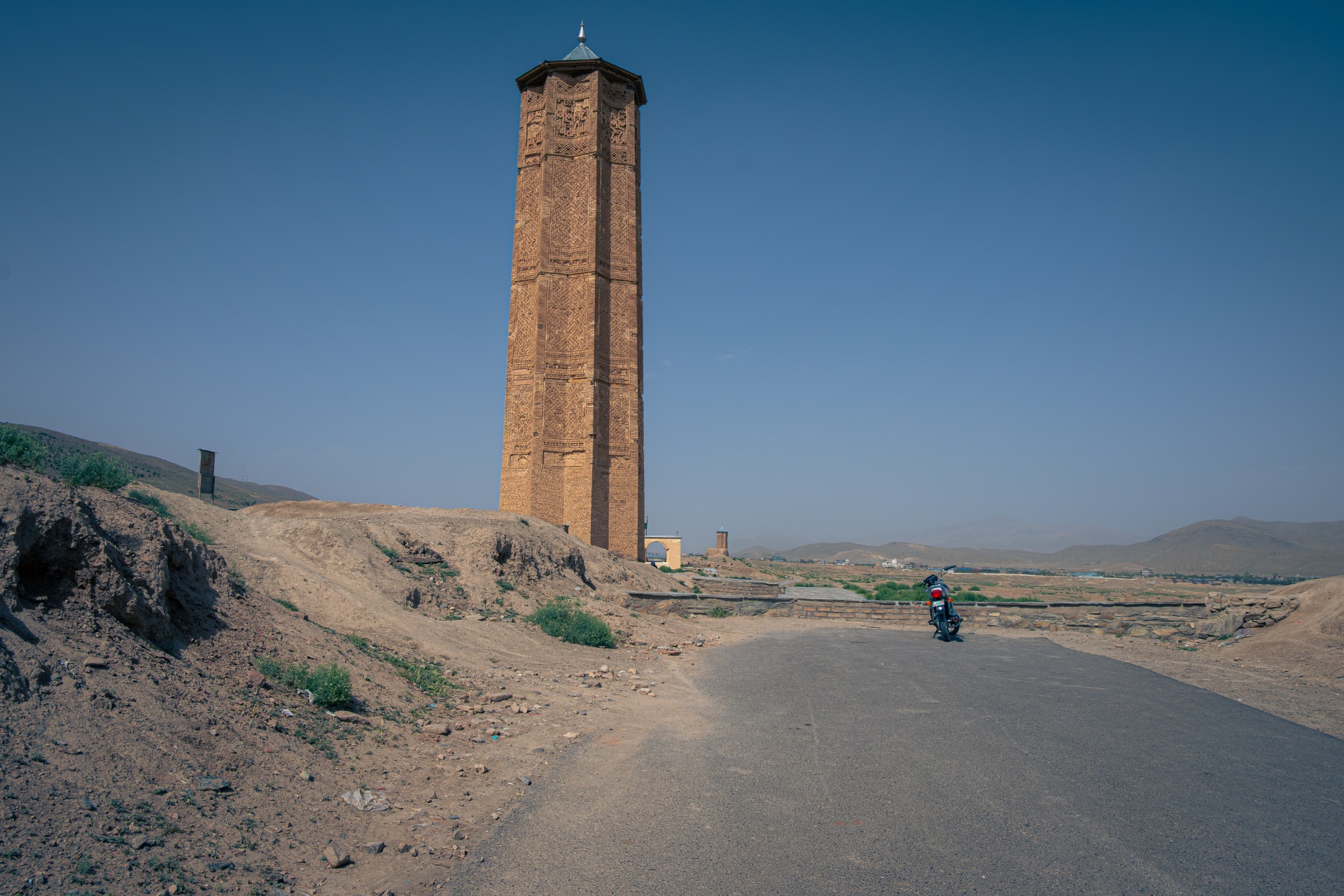
Standing almost alone on the plains outside the old city, the Minarets of Ghazni are among the most remarkable survivors of Afghanistan’s Ghaznavid past. Their intricate brickwork and unusual star-shaped forms belong to an age when Ghazni was not a remote provincial city, but the heart of an empire. From here, Ghaznavid rulers governed territories stretching across parts of Central Asia, Persia and the Indian subcontinent. Their capital became a celebrated centre of power, scholarship, poetry and architecture. Much of that imperial city has disappeared. The two minarets remain — slender fragments of a time when Ghazni stood at the centre of a much larger world.
History & Details
The two towers were constructed in the early twelfth century by Sultan Mas'ud III and his son Sultan Bahram Shah, rulers of the Ghaznavid dynasty. Although commonly known as minarets, their precise original function is not entirely certain. Archaeological evidence suggests they may once have been associated with important buildings or mosques that have since vanished. What survives is only the lower part of each original tower. Historical depictions show that the distinctive star-shaped brick shafts were once crowned by tall cylindrical upper sections, bringing their original height to more than forty metres. Their decoration reveals the extraordinary sophistication of Ghaznavid brick architecture. The surfaces are divided into elaborate bands of geometric and floral patterns, combined with inscriptions and decorative brickwork. Rather than covering the structure with another material, the builders transformed the brick itself into ornament. The towers also belong to a wider architectural story. Monumental brick towers appeared across the medieval Persianate and Central Asian world, reaching extraordinary refinement in Afghanistan. The Minarets of Ghazni are among the important surviving examples of this tradition.
Gallery
Visitor Experience
“Approaching the minarets is a striking experience precisely because so little of the imperial city remains around them. Two decorated towers rise unexpectedly from an open landscape, with the mountains of Ghazni forming a distant backdrop. Up close, their apparent simplicity disappears. Patterns emerge from the brickwork: lines, stars, inscriptions and geometric forms arranged with remarkable precision. Moving around the towers changes the light and shadows across their many-sided surfaces, revealing details that are almost invisible from a distance. Perhaps most evocative is imagining what once surrounded them. Palaces, mosques, gardens and busy quarters belonged to a city whose influence reached far beyond Afghanistan's present borders. Most have faded back into the landscape, while these two towers continue to mark the place where they once stood. The Minarets of Ghazni are more than remnants of a vanished city — they are two surviving signatures of an empire that once connected Afghanistan with the wider Persian and Indian worlds.”
Trips That Visit Minarets of Ghazni
Don't see a trip that fits? We can build one entirely around the places you want to see.
Plan a Custom Visit